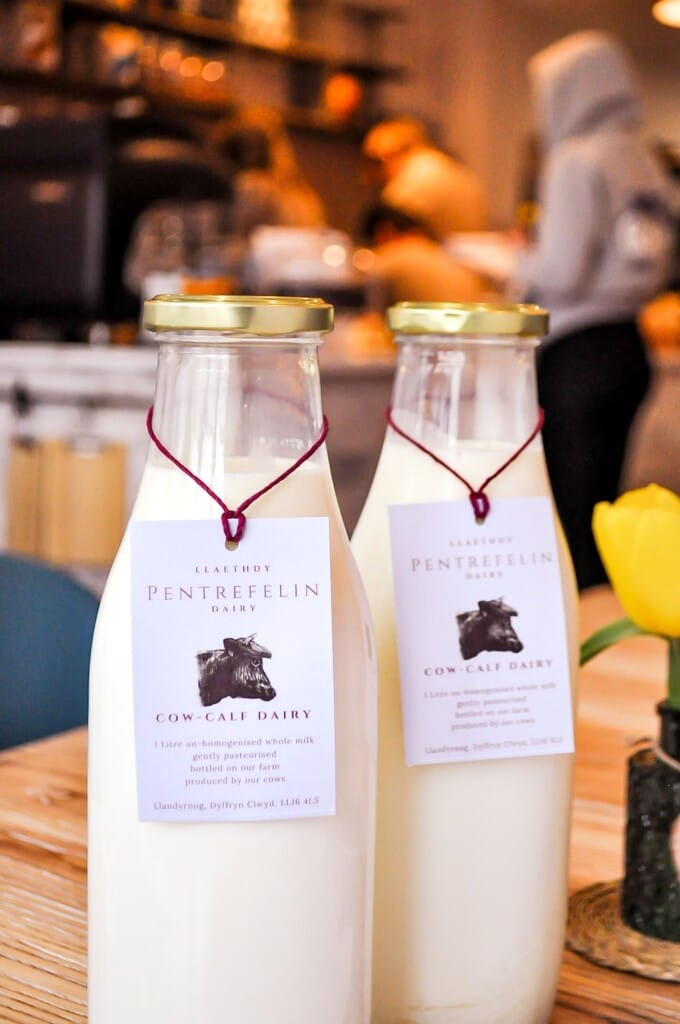
There’s a moment at Notos when the milk arrives from Huw at Pentrefelin. It comes in glass bottles – cold, satisfying to hold, and completely free of plastic. They’re lovingly used alongside our Heartland Coffee, then collected, returned to Huw & Team in Denbigh, cleaned, and refilled. Then they come back to us again.
It’s a simple thing, cyclical thing – something that has gone on for decades, but in a world where the hospitality industry is one of the biggest contributors to single-use plastic waste, it’s also a deliberate one. And we think it’s worth talking about.
The problem with plastic in cafes
Cafés and coffee shops can get through an enormous volume of plastic every week just by opening their doors. Milk cartons, condiment packets, takeaway cups with plastic linings, lids, straws, bags. Much of this is recyclable in theory but in practice, contamination from food and drink means a significant proportion ends up in landfill anyway.
When we set up Notos, we knew that the biggest area of environmental impact for a cafe is what you serve and how it arrives to you. Food and drink sourcing sits at the heart of our footprint. So we looked hard at every single element – and being such a core part of good coffee, milk was one of the first things we tackled.
Why Pentrefelin?
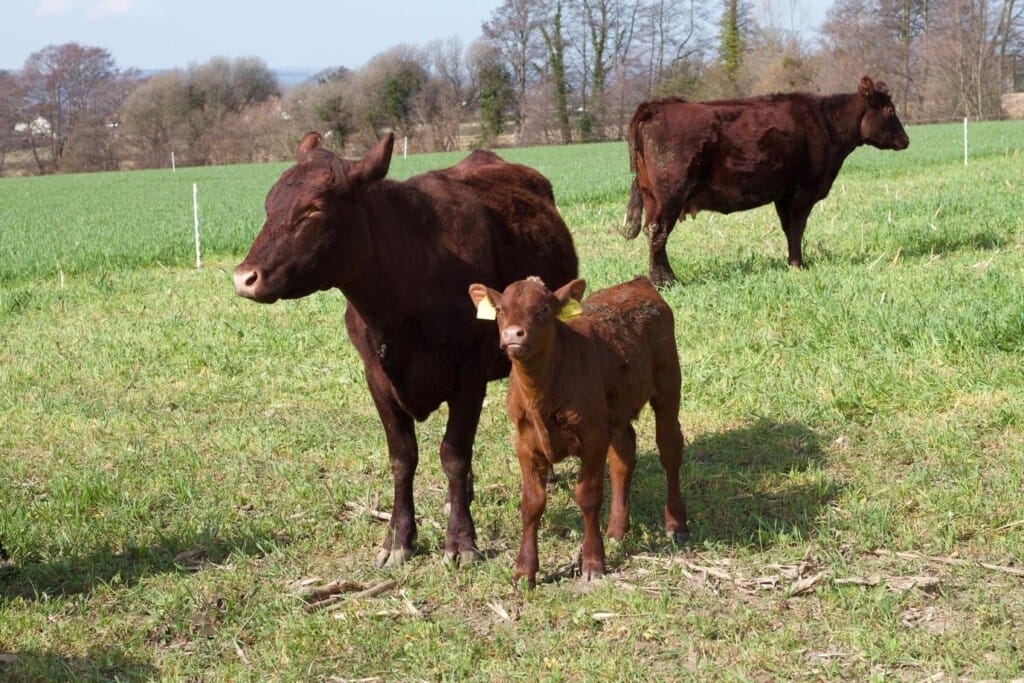
Pentrefelin is an independent dairy farm in Denbigh run by people who genuinely care about their land, their animals, and the environment around them. As a cow-calf micro dairy rooted in regenerative and permaculture principles, unlike industrial dairy farming, calves at Pentrefelin stay with their mothers during the milking process — a small thing that makes a significant difference to animal welfare.
Extending their positive impact beyond the boundaries of the farm is their delivery model. Their milk arrives at Notos in one-litre glass bottles. When they’re empty, we send them back. Pentrefelin cleans and refills them. The loop closes. No plastic ever enters the chain.
It sounds almost old-fashioned – and in a way, it is. The milkman model. But sometimes the old ways are the right ways, and this is a perfect example of a circular system that works: economically, environmentally, and in terms of the quality of the product.
Glass vs plastic vs recyclable cartons
We know some people ask: isn’t glass heavier, and doesn’t that mean more carbon in transport? It’s a fair question, and the answer is: it depends entirely on how many times the container is reused.
A single-use plastic bottle or carton, even a recyclable one, has a carbon cost attached to every single unit manufactured. A glass bottle that is used, returned, cleaned, and reused twenty or thirty times repays that manufacturing cost across all those uses. The maths changes dramatically when you factor in the whole lifecycle.
There’s also the question of what “recyclable” actually means. Recyclable packaging is only as good as the systems that process it. In practice, tetra-pak cartons and plastic milk bottles often aren’t recycled at the rates the labels suggest. Sometimes they are they contaminated, or they’re not collected, or the economics of recycling them don’t stack up. Glass in a closed-loop system, by contrast, stays in the loop.
What this means in practice at Notos
Practically speaking, our choice of Pentrefelin glass bottles minimises the amount of milk packaging that enters our waste stream. In a busy cafe that goes through significant volumes of milk for coffee, teas, and food preparation, that adds up to a lot of plastic that doesn’t exist.
It also means we can tell you exactly where every drop of milk in your flat white came from. A farm in Denbigh, pasture-raised cows, glass bottles cleaned and refilled. No mystery, no supply chain complexity, no compromise.
We think that transparency matters. In a food system that can feel increasingly opaque, where it’s hard to know where ingredients come from or what conditions they were produced in, being able to point to a real farm, a real family, and a real process feels important.
The bigger picture
The glass milk bottle story is one small piece of the way we think about sustainability at Notos. But it illustrates something we believe deeply: that sustainable choices aren’t usually dramatic gestures. They’re the accumulation of careful, deliberate decisions made consistently over time.
Every bottle returned to Pentrefelin is a small loop closing. Multiply that by every morning, every season, every year – and it starts to mean something. We’re proud of this one. Come in and give it a try.